SLA——Straight Linear Actuator
Can be Installed Side-by-side
High positioning repeatability
Adaptive Pushing
Can be Installed Side-by-side
High positioning repeatability
Adaptive Pushing
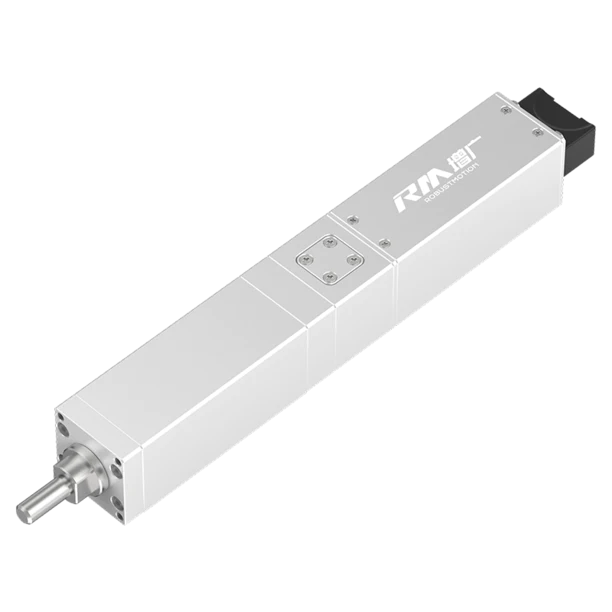
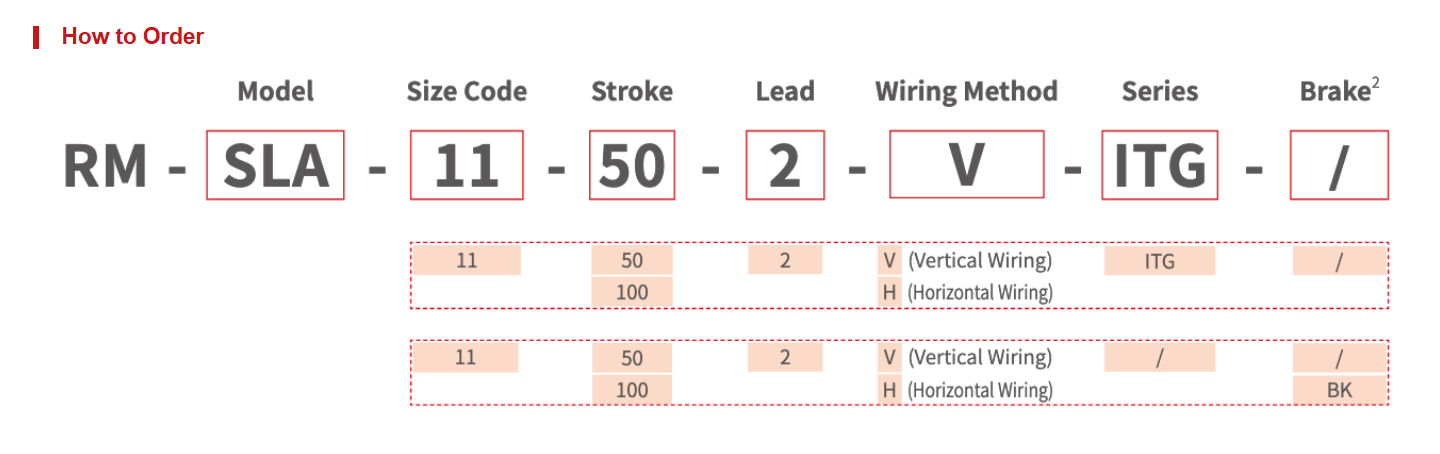

Straight Linear Actuator
| Model | RM-SLA-11-50-2-ITG | RM-SLA-11-100-2-ITG |
|---|---|---|
| Size Code | 11 | 11 |
| Weight | 0.7 kg | 0.9 kg |
| Dimensions | 288*35*35.5 mm | 338*35*35.5 mm |
| Stroke | 50 mm | 100 mm |
| Lead | 2 mm | 2 mm |
| Max. speed | 100 mm/s | 100 mm/s |
| Max. pushing Force1 | 300 N | 300 N |
| Max. Load Mass in Vertical | 1.5 kg | 1.5 kg |
| Repeatability | ±0.02 mm | ±0.02 mm |
| Linear Actuator Anti-Rotation Accuracy | ±1.5° | ±1.5° |
| Compatible Controllers | Built-in Controller | Built-in Controller |
| Bus Protocols | Modbus RTU; I/O | Modbus RTU; I/O |
| I/O Interface | 3 IN / 3 OUT (NPN) | 3 IN / 3 OUT (NPN) |
| Operating Voltage | DC 24V ±10% | DC 24V ±10% |
| Rated Current | 2A | 2A |
| Operating Environment | 0~40℃, < 85%RH | 0~40℃, < 85%RH |
| Protection Class | IP40 | IP40 |
Straight Linear Actuator
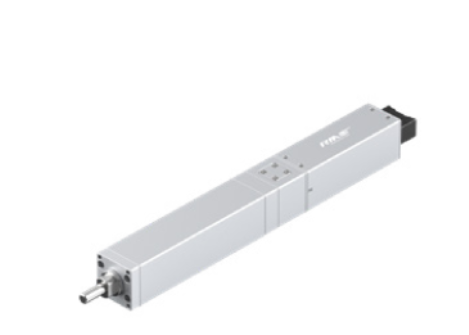
| Model | RM-SLA-11-50-2 | RM-SLA-11-100-2 |
|---|---|---|
| Size Code | 11 | 11 |
| Weight | 0.7 kg | 0.9 kg |
| Dimensions | 273*35*35.5 mm | 323*35*35.5 mm |
| Stroke | 50 mm | 100 mm |
| Lead | 2 mm | 2 mm |
| Max. speed | 100 mm/s | 100 mm/s |
| Max. pushing Force1 | 300 N | 300 N |
| Max. Load Mass in Vertical | 1.5 kg | 1.5 kg |
| Repeatability | ±0.02 mm | ±0.02 mm |
| Anti-Twist Accuracy | ±1.5° | ±1.5° |
| Compatible Controllers | RM-C-20; RM-CEP-20; RM-CEMS-20 | RM-C-20; RM-CEP-20; RM-CEMS-20 |
| Bus Protocols | EtherCAT; Modbus TCP; PROFINET; Modbus RTU; I/O (See Page 75 for details) | |
| I/O Interface | See controller specs | |
| Operating Voltage | DC 24V ±10% | DC 24V ±10% |
| Rated Current | 2A | 2A |
| Operating Environment | 0~40℃, < 85%RH | 0~40℃, < 85%RH |
| Protection Class | IP40 | IP40 |
Note: Test data measured in lab at 25°C.
Note: The drawings provided here are for the default standard model.
ITG model (Integrated): built-in controller within the actuator body.
Split Type Model: actuator with an external controller; a compatible controller must be selected when ordering.
For the specific compatible controller, please refer to the technical specifications of the series. Confirmation of the required communication protocol will determine the exact controller model.
Yes. Except for the RM-EGB series, all RM electric actuators should be connected using RM Software (V6 version).
Please refer to the user manual for detailed maintenance instructions for each product.
An electric linear actuator converts electrical energy into precise linear motion, enabling pushing, pulling, lifting, or lowering of loads. Powered by electric motors and controlled by programmable electronics, these actuators provide accurate force and position control for a variety of factory automation and industrial applications, including:
Compared to pneumatic or hydraulic systems, electric actuators offer higher efficiency, cleaner operation, and superior motion accuracy. They provide high precision, repeatability, and programmable control, allowing real-time adjustment of speed, position, and force. With energy-saving operation, lower maintenance, and easy integration with digital control systems, electric actuators are widely used in industrial automation, robotics, intelligent manufacturing, and precision handling applications.