Production Line Pain Points in Precision Workpiece Handling and Intelligent Gripping Solutions
How the RM-GBM Micro Electric Gripper Enhances Stability and Flexibility in Optical and New Energy Production Lines
I. On the Production Floor: The Gripping Link Is Becoming a Hidden Bottleneck in Precision Manufacturing
Against the backdrop of accelerated transformation toward intelligence, flexibility, and labor reduction in optical manufacturing and new energy battery production, the end effector of automated production lines has taken on a role far beyond simple handling.
Optical components are becoming increasingly thinner, lighter, and more precise, while new energy battery materials (such as electrode sheets and cells) demand ever-stricter requirements for surface integrity and positioning accuracy. The requirements for the gripping link have shifted from holding firmly to holding precisely, without damage, and with traceability. However, in many existing automated production lines, the gripping unit has become a weak link that limits capacity and quality improvement.
On-site engineers and equipment developers face the following core pain points:
Pain Point 1: Space Constraints and Insufficient Flexibility Limit Production Line Upgrades
The internal space of optical inspection equipment and new energy lamination/winding equipment is becoming increasingly narrow, while traditional grippers are relatively bulky, limiting the freedom of mechanism design and making multi-station layout difficult. At the same time, under the multi-variety, small-batch production model, frequent line changes require replacing fixtures and re-debugging, consuming changeover time and increasing equipment maintenance complexity, directly reducing the overall equipment effectiveness (OEE) of the production line.
Pain Point 2: Difficulty in Controlling Gripping Quality of Precision Workpieces, Lacking Effective Feedback
Optical lenses, filters, prisms, and other components, as well as battery electrode sheets, separators, and other new energy materials, are extremely sensitive to gripping force — insufficient force leads to slippage, while excessive force causes surface damage, deformation, or latent defects. More critically, traditional grippers mostly operate in open-loop control; the equipment cannot instantly confirm whether the gripping was successful, whether the workpiece has fallen off, or whether the dimensions are abnormal. Abnormalities are often only discovered at subsequent stations, leading to rework, scrap, and unplanned downtime, making true unmanned closed-loop control difficult to achieve.
II. RM-GBM Micro Electric Gripper: An Intelligent Gripping Solution for Optical and New Energy Production Floors
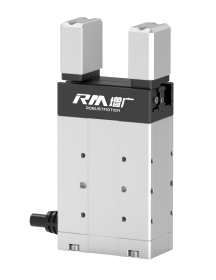
Addressing the above on-site pain points, RobustMotion has developed the RM-GBM series of micro electric grippers, with compact design, high-precision control, flexible adaptation, and intelligent feedback as the core design philosophy, already providing stable and reliable gripping performance in optical and new energy production lines.
RM-GBM Micro Electric Gripper
- Compact design: Slim body enables high-density placement in narrow equipment spaces.
- Flexible adaptation: Wide stroke and adaptive gripping cover multiple workpiece sizes.
- Repeat positioning: High-precision repeatability ensures assembly and inspection reproducibility.
- Intelligent detection: Drop detection, gripping status feedback, and size recognition support closed-loop control.
1. Slim and Compact Design, Releasing Internal Equipment Space
The RM-GBM adopts a slim structural design, achieving sufficient gripping stroke and force within an extremely compact body size.
For equipment development engineers, this means:
- Sufficient gripping capability can still be ensured within the narrow spaces of optical inspection equipment and new energy lamination/winding equipment
- Easier to achieve high-density parallel configuration of multiple stations
- Reduced interference risk with surrounding optical modules or battery mechanisms, shortening the design cycle
- Providing foundational conditions for the miniaturization and modularization of the overall equipment
In optical automated inspection equipment and new energy battery production equipment, such improvements in space efficiency have direct engineering value.
2. Large Stroke and Adaptive Gripping, Supporting Flexible Production
The RM-GBM features a large gripping stroke and adaptive gripping capability, covering workpieces of multiple sizes and specifications.
The tangible benefits for optical and new energy production floors include:
- Reduced fixture replacement during line changes: A single gripper can handle multiple varieties of optical components or different specifications of battery materials, significantly shortening changeover time
- Reduced fixture inventory and management costs: Decreasing the variety and quantity of dedicated grippers required
- Improved overall equipment effectiveness (OEE): Allocating more time to actual production rather than adjustment and preparation
- Enhanced production line flexibility: Rapidly responding to order changes, aligning with the multi-variety, small-batch production trend
3. High-Precision Repeat Positioning, Ensuring Reproducibility of High-Quality Assembly and Inspection
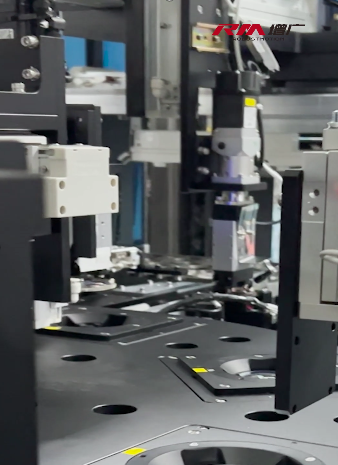
In optical component assembly and precision lamination processes for new energy batteries, the repeat positioning accuracy of the gripper directly determines the stability of product quality. The RM-GBM possesses high-precision repeat positioning capability, stably addressing the following application scenarios:
- Precision alignment and handling of optical lenses, filters, and prisms
- Assembly and inspection loading/unloading of optical modules
- Pick & Place of new energy battery electrode sheets and separators
- Cell transfer and precision assembly
For enterprises pursuing zero defects and process stability, precision is not merely a performance indicator, but a fundamental condition for ensuring consistent product quality across every batch.
4. Intelligent Detection Functions, Achieving Visualization and Traceability of Gripping Status
The evolution direction of modern automated production lines is moving from executing actions to autonomous judgment. The RM-GBM incorporates multiple intelligent detection functions:
| Function | On-Site Value |
|---|---|
| Drop Detection | Instantly detect the falling off of optical components or battery materials during handling, preventing empty gripping actions from flowing into subsequent processes |
| Gripping Status Feedback | Equipment can instantly confirm gripping success/failure, achieving closed-loop control |
| Workpiece Size Recognition | Identify dimensional abnormalities of optical components or electrode sheets during gripping, intercepting defective products in advance |
| Length Measurement Output | Output gripping data as process information, supporting quality traceability and data analysis |
These functions elevate the gripping unit from a simple actuator to an intelligent node with sensing capability. For enterprises advancing unmanned production lines, such feedback capability is a necessary condition for achieving Jidoka — that is, automatically stopping when abnormal, not passing on defects.
III. From “Holding Firmly” to “Holding Well”: Value Reconstruction of Gripping Technology
In the past, the task of grippers in optical and new energy production lines was merely to fix the workpiece. However, in the current precision manufacturing environment, the gripping link has been redefined as a strategic element affecting quality, efficiency, and flexibility.
The value of the RM-GBM micro electric gripper lies not only in its compact size and high-precision performance, but more importantly in its transformation of the gripping unit from a simple actuator into a perceivable, feedback-capable, and controllable intelligent process node.
For enterprises undergoing equipment upgrades, automation transformation, or new production line planning in the optical or new energy fields, adopting the RM-GBM means:
- Improved space efficiency: Achieving higher-density functional configuration within limited space
- Optimized line change efficiency: Shortening production preparation time with flexible gripping capability
- Proactive quality risk control: Eliminating defects before they occur through high precision and intelligent detection
- Data-driven manufacturing management: Providing underlying data support for production line digitalization and intelligence
As optical manufacturing and the new energy industry continue to evolve toward high precision, flexibility, and unmanned operation, the advancement of gripping technology will become an important infrastructure supporting the stable operation of the entire production line. What the RM-GBM provides is precisely an intelligent gripping platform for next-generation precision automated production lines.
Evaluating RM-GBM for Your Optical or New Energy Line?
Share your workpiece specifications, gripping forces, and cycle-time requirements. RobustMotion can recommend the optimal gripper configuration and intelligent detection parameters.